
Every Room Is a Classroom
An innovative general education curriculum takes a holistic approach to learning
By Jen Kinney
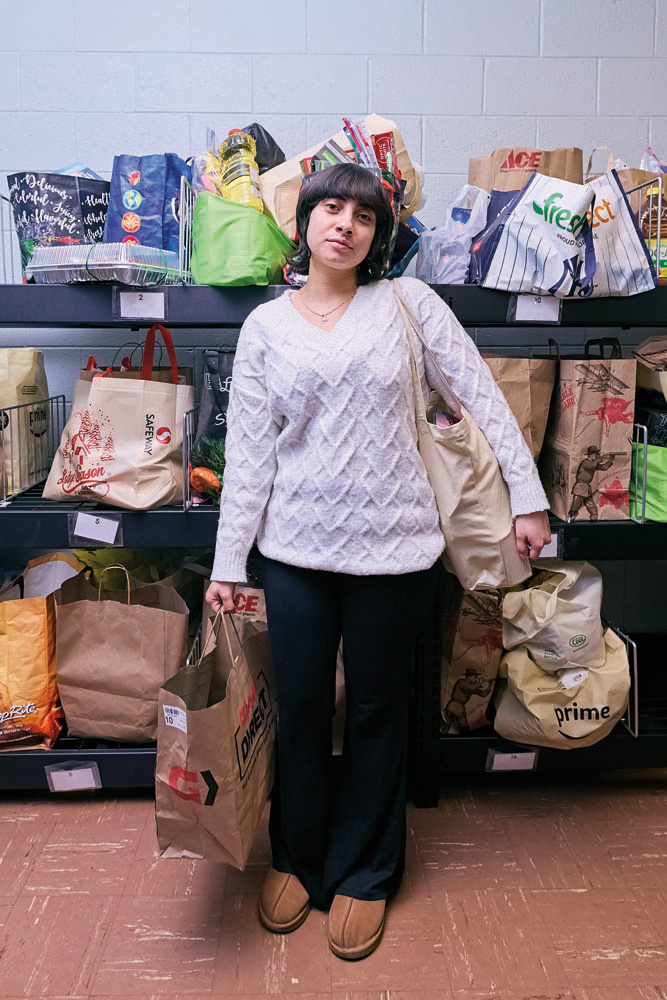
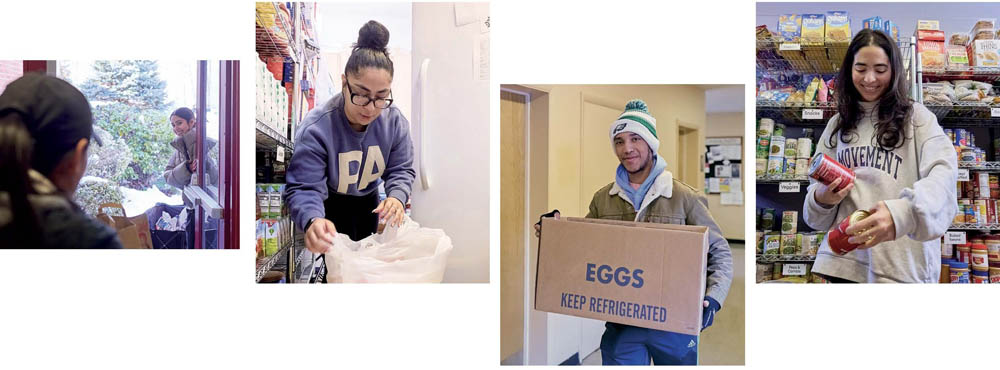
WHEN FAMILIES ARRIVED at the Interfaith Food Alliance in Morrisville, Bucks County, on a recent Saturday morning, they were greeted at the door by young volunteers. Outside, some offered bread and produce from local businesses. Inside, others made trips to the upstairs pantry to fetch grocery bags laden with cereal, milk, eggs, and cleaning supplies.
All were Holy Family University students on their last day of their community engagement class on food insecurity. For the past eight weeks, they had learned about food pantries and even designed their own. Now, they were getting a chance to see how a real pantry serves people in need of assistance.
The class and other community engagement courses like it are an innovative component of Holy Family’s new general education curriculum, which radically rethinks the foundational knowledge that students need, with an eye toward equity, student agency, and the University’s core values.
“We thought through the experiences and opportunities that are going to make students more marketable, more well‑rounded, and ultimately better equipped to lead a meaningful life because they are developing skills that open doors and support long‑term growth,” says Jenai Grigg, Holy Family’s assistant vice president of academic affairs. She says research shows most students will have multiple careers in their lives, so the redesign moves away from rote requirements and toward a holistic education— intellectually, practically, and spiritually.
Grigg chaired the ad hoc committee formed to develop a new curriculum. This is the third time that she has been involved in an overhaul of Holy Family’s general education curriculum since 2006. It’s no easy task: General education is foundational to a student’s university experience and touches multiple departments across campuses. In the past two revisions, the general education committee made limited changes to the traditional required classes, but this time around—in a process that started in 2021 as part of the University’s strategic plan—the committee was given a broad mandate to rethink the purpose of a general education curriculum from the ground up, creating an approach that reflects both the practical needs of today’s students and the mission and values of the University.

The committee proposed discarding the model of general education that once dominated higher education: a checklist of subjects students had to tackle, whether they felt applicable or not. The new curriculum would give students a stake in their own education. “Increasing student agency really was the focus,” Grigg says.
Holy Family began to roll out the new curriculum during the 2023–24 school year. It consists of four tiers. The first comprises a tightly focused base of required courses: writing, public speaking, philosophy, religion, and an inquiry-based science class. The second tier emphasizes academic breadth. Students can take any five courses from across the University, allowing them to explore interests outside of their major. The third tier is integration. These classes help students draw cross-disciplinary connections, with the goal of connecting diverse university subjects to each other and to real-world applications. And final tier of the new curriculum is a capstone that synthesizes everything students have learned in their major, their internships and field placements, and in the general curriculum. These classes are complemented by Blueprint, a series of one-credit, workshop-style courses designed to help students navigate college, the workplace, and beyond.
The ultimate goal is to encourage students to look at their education holistically. For example, says Grigg, “our nursing students need to be able to incorporate their psychology and sociology and history and political science into their nursing practice. We don’t learn in silos.”
THE FOOD INSECURITY CLASS, taught by Holy Family alumna Angela Cutchineal ’06, fits into the third tier: integration. This, says Grigg, is where many of Holy Family’s most innovative courses can be found. Some are taught by interdisciplinary teams, pairing humanities and natural-science professors. Many are service-based and experiential, like an American election course that culminates with students volunteering as poll workers, and others involve travel, like a three-week, language-immersion class in Barcelona.
Cutchineal is the economic self-sufficiency program manager at the Bucks County Opportunity Council and serves on the board of the Interfaith Food Alliance. Together, she and Grigg conceived of the food insecurity class, which blends a history of hunger in America and programs to alleviate it. The course gives students a systemic understanding of the causes and effects of hunger and poverty, a crucial perspective for Holy Family students, especially those who aspire to serve vulnerable populations as teachers, psychologists, nurses, or other service-oriented professionals. Student interest in the class was so high, Cutchineal developed a second community engagement class focused on the broader issue of generational poverty.
“Students need to be aware of what it truly looks like to be in poverty,” says Cutchineal. “If they’re going to be teaching in schools where a majority of kids are on the lunch ticket program, that means they’re coming from food-insecure houses. So, what does that mean? How do I meet the students where they are? What are the challenges that they’re overcoming before they enter the classroom?”
For the first seven weeks of the food insecurity course, students learn about food waste, public and private programs to address hunger, and existing resources in their own region. Cutchineal says students often come into the course with misconceptions even about the basic definition of food insecurity. At the start of class, many think that only people without jobs or homes struggle to put food on the table. They leave with a greater awareness of the many factors that can contribute to hunger, like low salaries, limited benefits, medical debt, divorce, and much more.
About 48 million people in the U.S. are food insecure, according to Feeding America, and rates of both poverty and food insecurity are higher in the Philadelphia region than the national average. About 17% of Philadelphians are food insecure—nearly 278,000 people—and in Bucks County, 9.9% of residents are food insecure. Across Pennsylvania, nearly two million people rely on SNAP federal food benefits, and food pantries in the region have experienced record demand over the past few months as those benefits have been cut.
For their final project, students design their hypothetical own food pantries to address this very real need. With a fictional budget of $3 million, students decide every aspect: where it’s located, who it serves, what it stocks, and what other crucial services it offers.
Every pantry will distribute food, “but do they also offer drug and alcohol counseling? Are there legal services? Is there grief counseling?” says Cutchineal. “Who else needs to be in the room to address all of the reasons that a person could be in poverty?”
Christopher Harvey ’29, a nursing major, chose to locate his pantry in West Philadelphia’s University City because of a striking statistic he learned: Approximately 31% of University of Pennsylvania undergraduates are food insecure. Knowing that the rest of West Philadelphia has dense pockets of poverty, Harvey saw an opportunity for his pantry to bring together local residents, students in need of assistance, and students who want to volunteer. His pantry would be mobile, arriving at the edge of campus four times a month, and also offer health screenings to students and neighbors alike.
In learning about food insecurity, Harvey sees a direct connection to his future work as a nurse. “In the medical field, you don’t know what you might see, not only with the condition, but people from different walks of life, different cultures,” Harvey says. “Having experience in this course teaches you how to care, how to sympathize, and gives you more insight into people who might be unfortunately more desperate or not as well off.” Kaileen Fermin ’29, a psychology major, also saw the course’s application to her studies—and her own life. “As someone who has been personally impacted by food insecurity in my life, I felt it was going to be extremely educating and enlightening to not only do the food pantry experience but to learn more about [food insecurity] and how it affects students and people through generations,” Fermin says.
Growing up with sometimes limited resources, Fermin says she and her family could have benefitted from a food pantry but didn’t utilize one. She’s interested in becoming a school counselor, where she can share her new awareness with her students. “ I’m going to take this as a resource to give to students who are eligible, like SNAP [food benefits], so that they won’t be limited in their nutrition because of money,” she says. “I’m very grateful that I was able to be educated on what I experienced and how I can fix that.”
Fermin’s final project incorporated creative ways to spread awareness about her fictional pantry and its services, like hosting Sip and Paint events as a way to get people in the door and talking about their services out in the community.
"I knew that I wanted my food pantry to be not only just a food pantry but a community gem. So, I wanted to have kid events, movie nights, craft days," says Fermin. "People talk about it. 'Hey, guess what I did last night? I went to the food pantry.'"
BUSTLING AROUND THE INTERFAITH PANTRY serving families this Saturday morning, students are making exactly the connections these classes were designed to promote—broadening their worldview and applying a systemic lens to both problems and solutions in society. “ Students get something from field experience and they get something from being in the classroom,” Grigg explained, “but if you can teach them about it before you go, their investment in that volunteering is exponential.”
Addressing food insecurity in particular can make students nervous, Grigg says. The course and its volunteer experience at Interfaith pushes them to interact with people they might not ordinarily and to confront poverty in challenging yet compassionate ways.
Volunteering at a food pantry is “the kind of thing you want to do, but you never do it,” Desere Jaipaul ’27 said, as she packed tampons and diapers into bags for visitors to take. This was the education major’s second visit to Interfaith as part of a Holy Family course; she had taken Cutchineal’s class on generational poverty and wanted to learn more.
Interfaith, which is located within the Morrisville United Methodist Church, is what’s known as a choice pantry. Families “shop” ahead of time by selecting items from a list, marking their preferences for soups, pasta, pancake mix, and other staples. Volunteers assemble their orders from the well-stocked pantry, lining up bags of nonperishables for each family, much like a grocery delivery service would. When families arrive, they give their name at the door and a runner goes upstairs to the pantry to retrieve their order. Another volunteer packs a bag with the cold, perishable items from their list. Each visit, families receive a roll of paper towels and four rolls of toilet paper, and once a month, they get basics like sugar, flour, cooking oil, and laundry detergent.
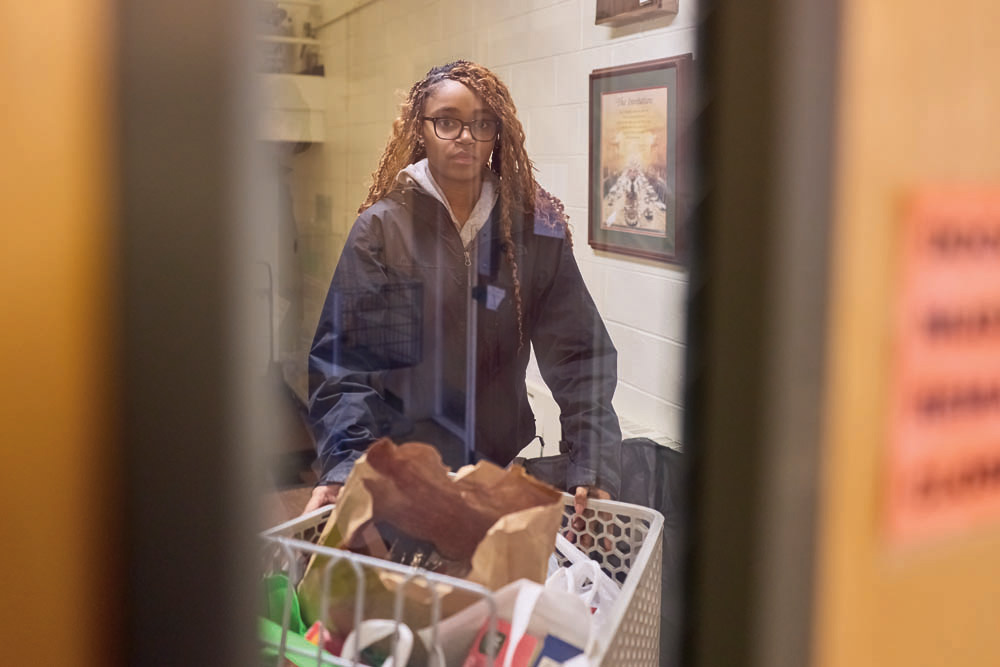
Volunteers load the supplies into shopping carts—sometimes three or four full bags in all—and help families out to their cars. Founded in 2015, serving just three families, Interfaith now feeds over 100 families each month, relying on donations of food and cash from corporations, grocery stores, and individuals. On this particular Saturday, about 25 families picked up donations. The Kukharemka family was among them.
Interfaith president Diane Coyle greeted the Kukharemkas with a cry of joy. Natalia Kukharemka and her husband Aliaksandr are both from Belarus. For the past five months, Aliaksandr was being held in immigration detention. Natalia had to drop out of school and start working two jobs, full-time at Amazon and at night driving for Uber, to support their two daughters, who are 13 and 16. Natalia needed help feeding her family and turned to the food pantry for the first time.
“I had support here. It’s really helped. And people pray for us,” she said.
Just days earlier, Aliaksandr was finally released, and Natalia brought him to meet the people who had been praying for him. They left with a cart full of groceries, packed by Holy Family students.