
The Nation’s Party Planners
What it takes to throw America’s birthday bash—and what the celebration will mean for the region
By Jennifer Myers
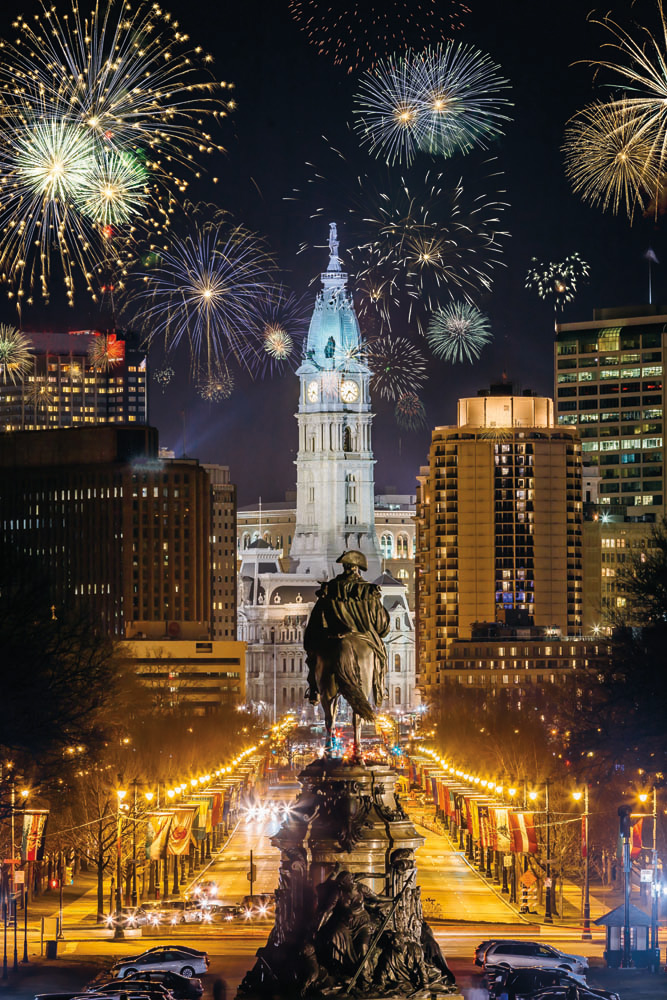
PHILADELPHIA IS AMERICA’S BIRTHPLACE, and for nearly 250 years, the city has also been the epicenter of the nation’s birthday celebrations. In 1777, there were bonfires, music, and fireworks. A century later, the Centennial Exposition introduced the world to the typewriter, Heinz ketchup, the electric light, and the telephone. The sesquicentennial in 1926 reshaped the city’s landscape with landmarks like the Benjamin Franklin Parkway and the Benjamin Franklin Bridge, and the 1976 bicentennial brought cultural institutions and enduring icons such as the LOVE sculpture.
“It’s all about us,” says Dana Russikoff ’92. “This is where it all started, and we’re proud.”
Russikoff is the executive director of One River Alliance, a nonprofit that connects neighborhoods to the Delaware River through programming. Since 2019, the organization has hosted the July 4 FreedomFest in Pleasant Hill Park in East Torresdale. The event was inspired by the all-day Fourth of July gatherings Russikoff remembers as a kid at her grandmother’s in Lawncrest, but it quickly grew from a fireworks show into an all-out party with food trucks, live music, beer gardens, children’s activities, and even a Ferris wheel that affords revelers sweeping views of the river. Russikoff and her team have been planning for 12 months for the country’s 250th, which will include a grand fireworks finale and the installation of Pleasant Hill Park’s first permanent flagpole.
“When the fireworks are done and the finale’s over—everybody just clapping and hooting and hollering and the yells and the screams—I get emotional just thinking about it,” Russikoff said. “It just brings us back to the basics and instills a real sense of civic pride.”
Tourism experts estimate that the region could see more than one million additional visitors this year drawn to the semiquincentennial and adjacent events. Everyone wants to be associated with the celebration, from Netflix, which opened its Netflix House attraction at the King of Prussia Mall, and Cirque du Soleil to the marquee sports leagues scheduling their signature matchups— the FIFA World Cup, the PGA Championship, and the Major League Baseball All-Star Game.
Valley Forge National Historical Park is among them. “I think we’re going to see an increase in visitation and therefore a positive economic impact, and we hope the lasting impression that people have is ‘wow, Valley Forge and Montco are great places to stay, and I want to go back,’” explains Rachel Riley ’04, vice president of marketing and communications at the Valley Forge Tourism & Convention Board. The organization has been planning for 2026 for two years. In addition to being the nation’s 250th, this July 4 also marks the 50th anniversary of the establishment of Valley Forge National Historical Park—the only national park that shares a birthday with the U.S. And the region is ramping up to commemorate the 250th anniversary of George Washington’s encampment at Valley Forge for the winter of 2027–2028. “We are encouraging everyone to retreat to Valley Forge now and return later,” Riley says.
Visitors to the region will find opportunities everywhere to learn more about the founding of the country: The First Bank of the United States, closed to the public since the bicentennial, will reopen in July with exhibits about American diplomacy and Philadelphia’s role in celebrating the country, and traditional cultural sites like the Philadelphia Museum of Art and the Museum of the American Revolution are hosting special events throughout the year. But the country’s story will also be on display in less expected spots, such as along the southern Delaware where the Delaware River Waterfront Corporation is curating “As Freedom Flows,” an open-air art gallery stretching from Cherry Street Pier past Spruce Street Harbor Park. “We want to be a complementary resource to all the other things going on in the city to make sure that the people connect fully all the way around,” says Joe Forkin ’95, president and CEO of the organization.
Installations along the waterfront will include artist Paul Ramírez Jonas’s “Let Freedom Ring,” an interactive piece that plays “My Country ’Tis of Thee” and invites the listener to complete the song by ringing a 600-pound bell, and “Roots of Resilience,” a collection of flags designed by different artists in celebration of Philadelphia’s immigrant spirit. The goal is to draw both visitors and locals to the river, now and for years to come.
For Forkin, the real test will come after the crowds disperse.
“Have you properly set yourself up to take advantage of that year, a year from when it ends?” he says. “All of the programmatic activity that you placed in there, all the activations that you did, all the street cleaning and murals and flower planting and tree planting and all of that stuff to increase the visitor experience to Philadelphia, is that going to be maintained throughout?” That, he says, is what will ultimately determine if the semiquincentennial is a success in America’s hometown.