
What Happens After Graduation? Three Recent Holy Family University Grads Share Their Stories
By Mark Hostutler, Bucksco.today
For students choosing a college, one question often matters as much as the major they plan to study or the campus they hope to call home: What happens after graduation?
Colleges and universities track that question through graduate outcomes data, following alumni after they complete their degrees to understand whether they are working, continuing their education, or pursuing other post-graduate opportunities.
The most recent data from the National Association of Colleges and Employers found that 85.7 percent of bachelor’s-degree graduates from the Class of 2024 were employed or enrolled in further education within six months of graduation.
At Holy Family University, the most recent graduate-outcomes data shows that 92 percent of graduates were either employed or enrolled in graduate school within one year of earning their degrees.
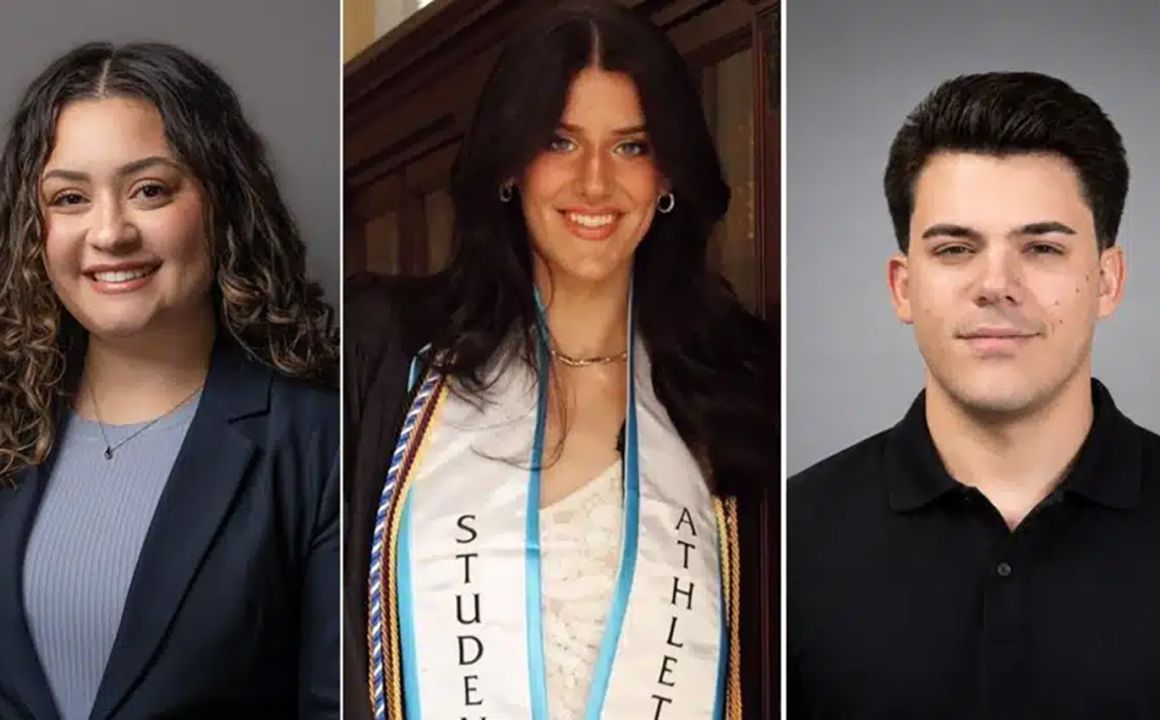
Three recent Holy Family graduates offer a glimpse of what those paths can look like: one beginning a career with a global accounting firm, one continuing to law school after working in the courts, and one building an artificial-intelligence company with a fellow graduate.
Claire Dougherty: Turning an Internship into a Career
When Claire Dougherty arrived at Holy Family as a student-athlete from northeastern Pennsylvania, she wasn’t entirely sure what direction she wanted to take. “I sort of thought pre-med was what I was expected to do,” she said. “But I especially loved numbers.”
She began exploring different business majors — and then took her first accounting course.
“I switched immediately,” Dougherty said. “It’s the language of business. You can get an accounting degree and go into anything in business. I loved the opportunity it came with.”
Once she found accounting, Dougherty built her college experience around the classroom and the opportunities beyond it.
A member of Holy Family’s women’s basketball team, she also worked as a team lead at Saxbys, participated in the Business Society, and served on the Student-Athlete Advisory Committee.
Her most demanding semester came last spring during her senior year, when she completed a full-time internship with KPMG while carrying a full course load and finishing her final basketball season. Many days started with a 6 AM train ride into Philadelphia and ended with basketball practice after work.
On the ride back to campus, she watched game film over Zoom, so she could stay connected with her team.
“I don’t know any other coach who would let a player do this,” she said of women’s basketball coach Bernadette Laukaitis. “My professors were so supportive.”
A faculty member also helped make the internship experience possible.
When Dougherty needed an advanced taxation course offered online rather than in person to accommodate her schedule, accounting professor Terese Kazzaz worked with the university to make it available.
“That speaks for the personal relationships you can develop at Holy Family,” Dougherty said. “At a bigger school, they wouldn’t have made that change.”
Career Services also helped prepare her for the next step. After earning an interview with KPMG, Dougherty met with Career Services Director Brett Fucci for a mock interview.
“We went through the wording of everything,” she said. “They helped with my résumé. And they jumped up and down when I got the offer. The level of support is incredible.”
The internship led to a full-time opportunity. In March of her senior year — the same month Holy Family women’s basketball won its first regional championship — Dougherty learned she had earned a full-time offer from KPMG.
Mia Peahota: From History Major to Law School
Mia Peahota was drawn to Holy Family because she wanted an education where she would be known — not just another name on a roster.
“I wanted a small school that could give me a more personalized education,” she said. “In some classes, I had as few as six students.”
She also arrived with a clear goal: “I always knew I wanted to become an attorney.”
As a history major, Peahota discovered that the skills she developed in the classroom extended well beyond the study of the past.
An American foreign policy course, in particular, changed the way she viewed the field. “It made me see how applicable history is to everything,” she said. “I think of it every time I read the news.”
She credits history professor Dr. Mary Carroll Johansen, who also served as her advisor, with helping shape her academic experience. When she needed additional support, she found resources available through the university.
“I never truly struggled,” Peahota said. “They had tutoring programs and resources. I was never lost.”
Her first professional step into the legal field came through Career Services. Career counselor Schyler Paris-Ellerbee shared her résumé with employers, leading to an internship with a Bucks County attorney.
“I feel so fortunate that I worked with an attorney who was so welcoming,” Peahota said. “He wanted me to see everything.”
The internship gave her firsthand experience with the legal process, from working alongside attorneys and paralegals to attending court proceedings. It also reinforced lessons she had learned through a professional development course at Holy Family.
“A big thing was learning how to ask for feedback,” Peahota said. “It’s intimidating to do, but it’s important.”
After graduation in 2024, that experience helped her secure a position as a judicial clerk in Bucks County, where she gained additional exposure to the court system before beginning law school at Drexel University’s Thomas R. Kline School of Law this summer.
Today, she sees connections between her undergraduate education and her legal studies. “Studying history taught me how to read for two hours straight,” she said.
Todor Karamoutchev: Building the Future Through AI-Native Companies
For Todor “Toby” Karamoutchev, graduation last spring did not mean beginning a traditional job search. Instead, it meant continuing to develop a business he had already started with fellow Holy Family student Bogdan Stere.
The pair initially worked in web design, search engine optimization, and digital marketing. But as artificial intelligence began changing the industry, they decided to learn a new set of skills.
“We realized that 80 percent of the work we were doing was using new emerging technologies,” Karamoutchev said.
While balancing classes and athletics — Karamoutchev played baseball and Stere played soccer — the two spent months teaching themselves programming, coding, and AI development.
“We had classes four days a week,” Karamoutchev said. “I was in baseball, and Bogdan was in soccer. It was a lot to balance, but we fully dedicated ourselves to this.”
Their work eventually became Vertical AI Labs, a company that develops custom artificial intelligence tools designed to help businesses automate processes and improve efficiency.
Karamoutchev credits Holy Family faculty members with supporting that work from the beginning. “None of this would be possible without the tremendous support we’ve had at Holy Family University with our professors,” he said.
That support has continued after graduation, with faculty members advising projects and remaining involved as the company grows.
Despite working in one of the fastest-changing areas of technology, Karamoutchev said some of the most important lessons he learned in college were not technical.
“The biggest thing I learned is how to listen and connect to people and how to see things through from start to finish,” he said. “Learning to persevere — to finish.”
As a first-generation college graduate whose family emigrated from Bulgaria to South Africa before settling in Canada, he said he understands the significance of the opportunity to earn a college degree.
“The biggest point I’m trying to make is: it is hard to get into a university,” Karamoutchev said. “If you are going to college, you are already ahead of so many people. I am so grateful to have gone to university.”