
Holy Family’s New Master’s Program in Applied Behavior Analysis Aims to Meet Field’s Surging Demand
By Mark Hostutler, Philadelphia Today
The demand for qualified behavioral health practitioners — professionals who help people address challenges related to mental health, emotional well-being, and behavior — is outpacing the supply.
School districts have openings. Clinics are managing waitlists. Community agencies are searching for specialists trained in evidence-based intervention. A quick scan of job boards reveals hundreds of local listings for behavior analysts, and it’s a reflection of a workforce gap that continues to widen.
In response to that growing need, Holy Family University has launched a new Master of Science in Applied Behavior Analysis (ABA), designed to prepare professionals for one of the fastest-growing roles in behavioral health and education.
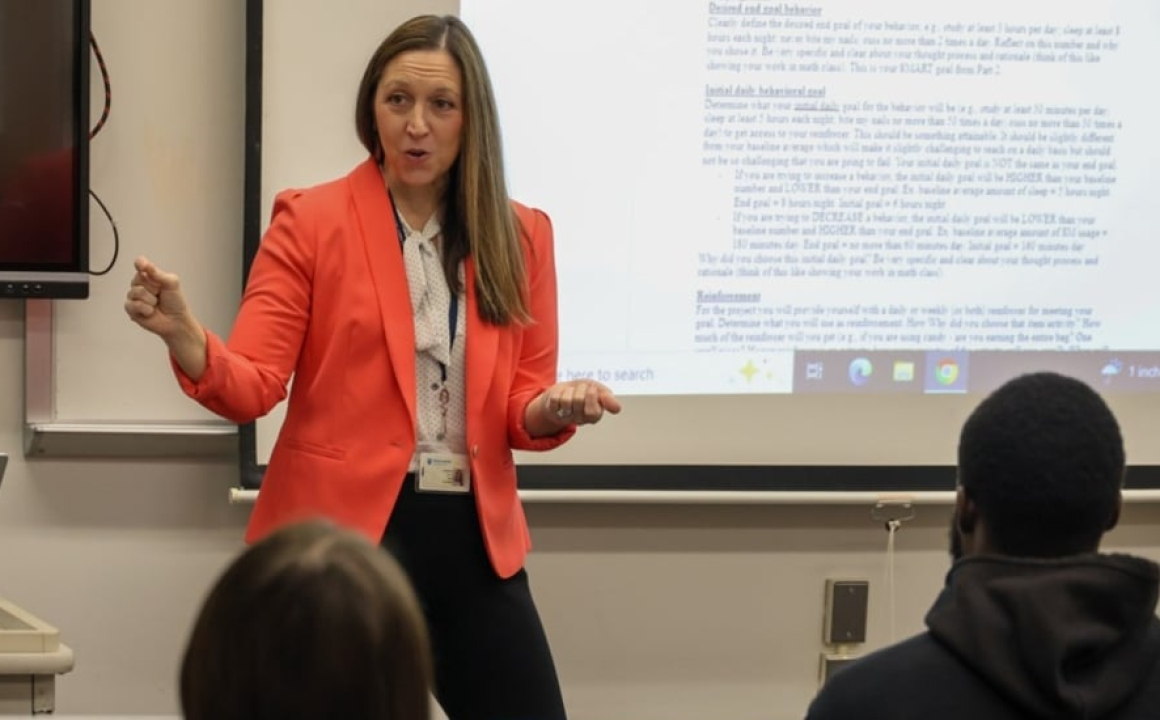
The program, which welcomed its first cohort this fall, is led by Dr. Katharine Croce, an associate professor of psychology at Holy Family. Croce is a board-certified behavior analyst who understands firsthand both the urgency of the demand and the life-changing potential of the work.
The program, which welcomed its first cohort this fall, is led by Dr. Katharine Croce, an associate professor of psychology at Holy Family. Croce is a board-certified behavior analyst who understands firsthand both the urgency of the demand and the life-changing potential of the work.
Croce’s path into behavior analysis began unexpectedly in the early 2000s, when she was an undergraduate psychology major. She came across a classified ad seeking psychology or education students to work with a young child facing developmental challenges.
At the time, Applied Behavior Analysis was far less visible than it is today. Insurance coverage was limited, formal programs were sparse, and many services were delivered privately in homes.
“I knew almost nothing about it,” Croce said. “Even as a psychology major, it wasn’t something we deeply studied.”
That summer changed everything.
She began working with a three-year-old child who was nonverbal and struggled to communicate. Through structured, data-driven intervention grounded in behavioral science, Croce saw steady progress. The child began using single words to communicate needs and wants. Engagement increased. Joy surfaced.
“I watched him go from running away from me when I arrived to waiting at the door,” she said. “Seeing how the science of behavior could unlock that kind of growth — I was hooked.”
The experience redirected her academic plans. She earned her master’s degree in Applied Behavior Analysis and went on to build a career in clinical practice and higher education.
Now, she is helping build the next generation of practitioners at Holy Family.
While many behavior analysts work with individuals on the autism spectrum, the scope of the field is much broader. ABA practitioners support people across the lifespan in developing communication, academic, social, vocational, and organizational skills. They work in public and private schools, hospitals, behavioral health clinics, residential programs, and corporate or organizational settings focused on performance and systems improvement.
Still, one of the primary drivers of demand remains the steady increase in autism diagnoses. In 2025, approximately one in 31 children was identified with autism spectrum disorder. Those numbers translate into substantial service needs — and significant workforce pressure.
“If you picture a classroom of 25 to 30 students, statistically at least one of those children may require behavioral support,” Croce said. “And those needs don’t disappear as children grow up. They evolve.”
The result is a profession experiencing rapid growth. The U.S. Bureau of Labor Statistics projects strong demand for related behavioral and mental health roles in the coming decade. Regionally, employers are competing for a limited pool of board-certified behavior analysts (BCBAs), often offering sign-on bonuses and flexible arrangements to recruit talent.
Holy Family’s new graduate program is designed to help close that gap.
Beyond its flexible format, Holy Family’s new ABA program is built around a scholar-practitioner model that blends academic rigor with real-world experience. The university offers two pathways. Its 4+1 accelerated option allows psychology majors to begin graduate coursework during their senior year, earning both a Bachelor of Arts in Psychology and a Master of Science in Applied Behavior Analysis in five years. Students apply as juniors, complete four graduate courses as seniors, save an estimated $10,000 in tuition, and transition seamlessly into full-time graduate study with early practical experience already underway.
For those who already hold an undergraduate degree, the traditional standalone master’s program provides comprehensive preparation in behavior analysis and readies graduates to pursue BCBA certification, supported by faculty mentors committed to long-term professional development.
“We wanted to create multiple entry points,” Croce said. “There are people already working in helping professions who are ready for the next step.”
Most students enrolled in the program are working full time in education, counseling, social services, or related fields. Some are parents motivated by personal experience navigating behavioral systems. Recognizing the realities of adult learners, Holy Family structured the program as live, synchronous online instruction.
Classes meet virtually in real time, combining flexibility with interaction. Students can log in from home after work, participate in discussions, and engage directly with faculty and peers.
“If someone isn’t a strong asynchronous learner, but can’t commute to campus for a three-hour class, this format works,” Croce said.
Class sizes are intentionally small to foster close mentorship. Students can ask questions aloud or use private chat features if they are hesitant to speak in front of peers.
“It’s about accessibility,” Croce said. “There may be incredible future behavior analysts out there who just need the right structure to access the training.”
The small-cohort model also allows faculty to prioritize community. Behavioral work can be emotionally demanding, with meaningful victories and difficult setbacks. Croce believes students benefit from a supportive learning environment that models the compassion they will extend to clients.
For Croce, the mission remains deeply personal. She still thinks about that first child she worked with, the one who once ran away when she knocked on the door and later waited eagerly for her arrival.
“That kind of change,” she said, “is why this field matters.”