
Holy Family’s MFA in Creative Writing Offers Flexible Path for Writers Balancing Work, Life, and Their Craft
By Mark Hostutler, Philadelphia Today
When Holy Family University welcomed its first Master of Fine Arts in Creative Writing cohort in 2024, the program had already been years in the making.
For Dr. Keith Kopka, who began building the program in 2021, the goal wasn’t to replicate a traditional graduate writing experience. It was to build one from the ground up that reflected how students and aspiring writers actually live and work today.
At the heart of Holy Family’s program is its low-residency model, a structure that flips the expectations of graduate education in creative writing.
In a traditional MFA, students often relocate, immersing themselves full-time in a campus-based experience for two or three years. It’s a model that understandably comes with tradeoffs.
“You kind of have to pick up your entire life and move to a different state or a different city,” Kopka said.
Holy Family’s program takes a different approach.
Most coursework happens remotely, built around one-on-one mentorships between students and faculty. Instead of large workshop settings where attention is divided, students work closely with established, award-winning writers who provide detailed feedback and guidance on their work.
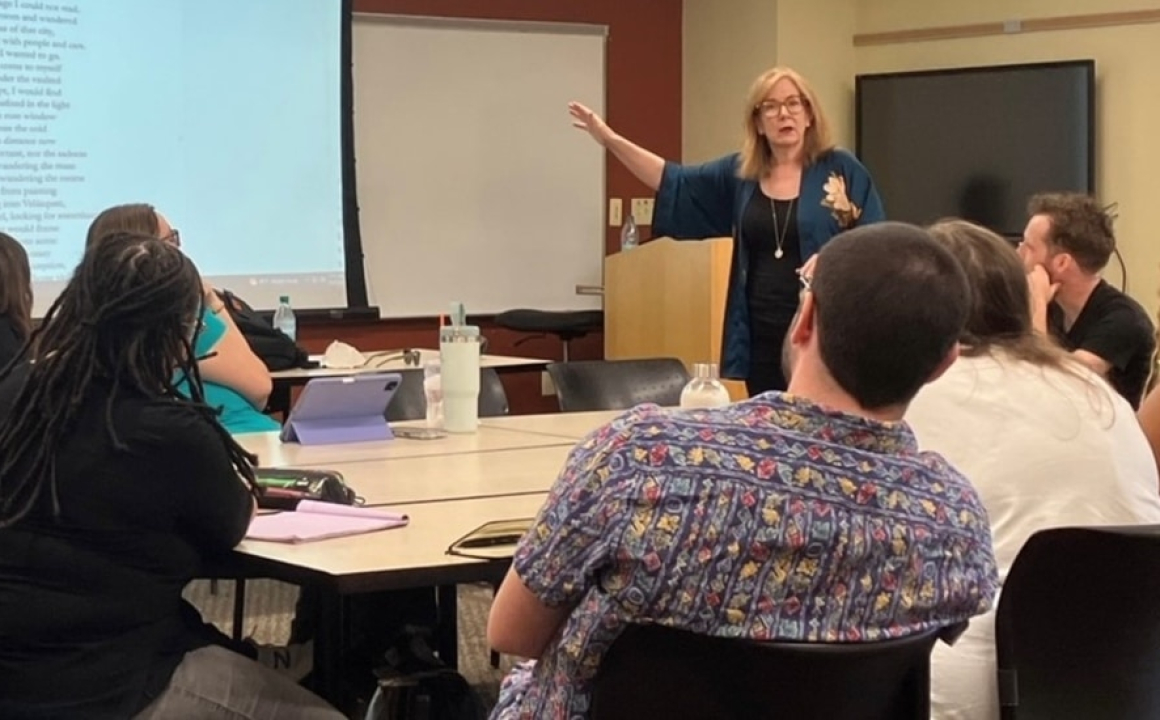
Twice a year, students come to campus for residencies, but even those have been reimagined.
Rather than requiring 10- to 14-day stays, which are common in other low-residency programs, Holy Family compresses its in-person experience into a long weekend. Those residencies are then supplemented by virtual sessions held over a weekend during each semester.
The result is the same level of engagement, delivered in a format that better fits into people’s lives.
“It’s designed for all kinds of folks — people who might not be able to move, people who are working, people who have children, people who have other commitments, or people who are just looking for a different kind of graduate experience,” said Kopka.
That flexibility shows up in the student body.
“Our students come from all walks of life,” said Kopka. “We have people who are currently secondary education teachers. We have people who are ex-military. We have people who are stay-at-home moms and dads. We also have people who just graduated college.”
Geographically, the students span just as wide a range, from Bucks County and Philadelphia to distant states like Texas and Arizona.
“It really can work for anyone,” Kopka said.
And because the program is built around mentorship, that diversity becomes an asset, not a challenge. Each student’s path is shaped individually, guided by both their creative goals and their lived experience.
Like most MFA programs, Holy Family’s end goal is clear: help students produce a book-length manuscript.
But the way it gets there — and what it emphasizes along the way — sets it apart.
The one-on-one mentorship model allows students to develop their work in depth, forming what Kopka describes as a “symbiotic relationship” with faculty. Over time, that relationship helps refine not just the writing itself, but the writer’s voice and direction.
By the end of the program, students can expect to have a manuscript that’s ready to enter the publishing world.
But Holy Family doesn’t stop there.
“One of the things we emphasize is that you have to have a life in writing after you graduate,” Kopka said.
That philosophy is built into the program through what it calls “interdisciplinary practice” — customized, faculty-guided projects that help students connect their writing to professional opportunities.
For some, that means launching literary magazines. For others, it means developing creative writing curricula within schools. One student even worked with Kopka to build a presence as a book influencer on TikTok — an increasingly viable path to publishing opportunities.
The idea is that writing is not just an art. It’s a long-term practice that intersects with careers, communities, and evolving platforms.
“A life in writing is a marathon, not a sprint,” Kopka said.
The program’s low-residency structure also opens doors that traditional programs often can’t.
Because not all residencies are tied to physical travel, Holy Family can bring in high-profile writers from across the country, sometimes for extended engagement with students. That includes Pulitzer Prize-winning authors like Carl Phillips, who led a multi-day virtual residency.
“For students to get that kind of access is a huge deal,” Kopka said.
Perhaps the most distinctive element of Holy Family’s MFA, however, is philosophical.
In many MFA programs, genre writing — science fiction, fantasy, romance, and other popular forms — is often sidelined in favor of more traditional literary work.
Holy Family takes the opposite approach.
“We treat those genres as equals,” Kopka said.
That means students interested in speculative fiction or romance are not only welcomed but supported with the same level of rigor and mentorship as those working in literary fiction, nonfiction, or poetry.
It’s a decision rooted in both creative respect and practical awareness.
“These are the things people are reading,” Kopka said. “And quite often, they’re the things that allow our students to be successful in publishing.”
For Kopka, the program represents more than a new academic offering. It’s a response to how writing, and writers’ lives, have changed. Flexible, mentorship-driven, and open to all forms of storytelling, it meets students where they are, while still pushing them to where they want to go.